




PPWR enforcement is imminent, ATEX export compliance threshold is rising
Starting from August 12, 2026, the EU's Packaging and Packaging Waste Regulations (PPWR) will enter the enforcement stage, and packaged industrial equipment sold to the EU will face new extended packaging producer responsibility (EPR) compliance requirements. For export categories such as ATEX explosion-proof lamps, explosion-proof fire-fighting robots, and explosion-proof alarms, the packaging registration number is no longer just ancillary information, but a prerequisite that directly affects platform listing, customs clearance, and contract performance. Therefore, this change deserves the simultaneous attention of enterprises related to foreign trade, distribution, procurement, and bidding.
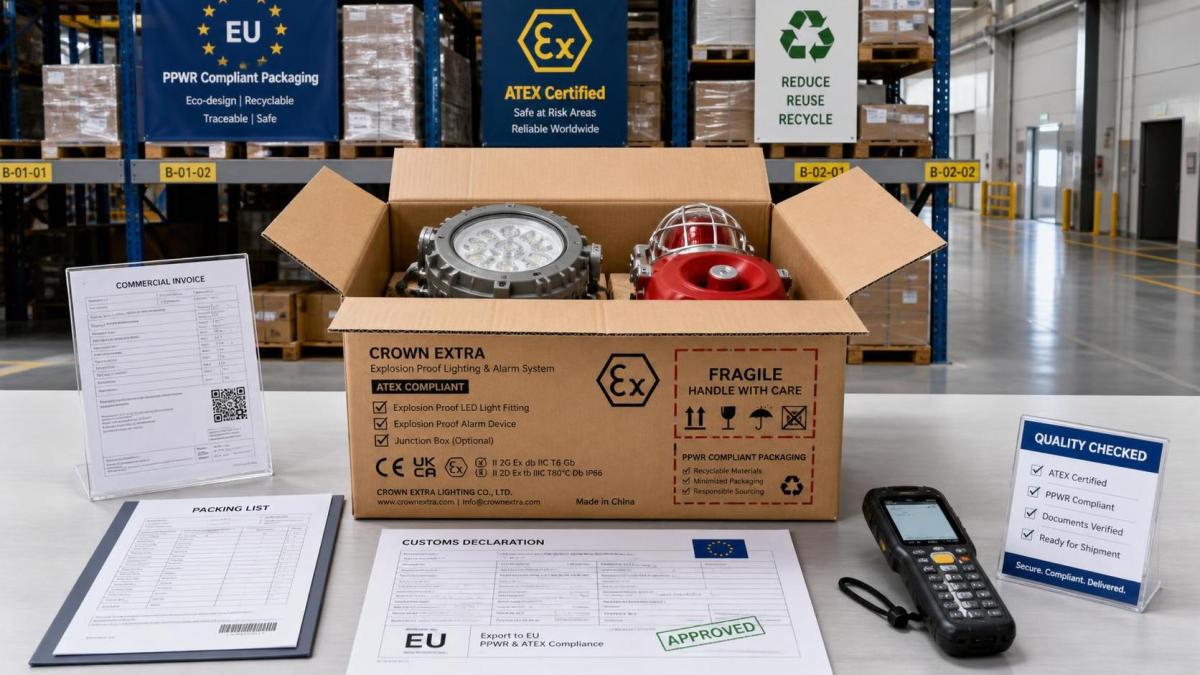
The EPR registration number of the target country begins to enter the export chain
Confirmed information shows that the EU PPWR will be fully mandatory and effective from August 12, 2026; all industrial equipment sold to the EU and packaged must complete the Extended Producer Responsibility (EPR) registration of the target country and upload the registration number. The incident summary clearly named ATEX explosion-proof lamps, explosion-proof firefighting robots, explosion-proof alarms and other high-risk environmental equipment as being within the scope of the impact. Products that fail to comply may face removal from Amazon and other platforms, seizure by customs, and heavy fines. As for the message itself, the focus is not on individual products, but on how packaging compliance is embedded into cross-border sales and delivery.
Which links will feel the pressure first
The customs clearance information of exporters and distributors will be more sensitive
For direct trade companies and global distributors, the most directly affected are pre-shipment data preparation and customs clearance cooperation. Since the registration number needs to be uploaded, the connection between the company's order confirmation, delivery arrangement, platform filing and customs clearance declaration will be closer. For models that originally relied on spot shipments or multi-country distribution, these new thresholds will amplify the risks of missing documents, inconsistent information and delivery delays.
Procurement contracts and delivery terms need to be rechecked
Both purchasers and export companies may need to reexamine the allocation of compliance responsibilities, delivery preconditions and default clauses in the contract. From an analysis point of view, this type of change is not just "one more registration", but will affect who is responsible for registration, who will bear the consequences of delisting or deducting goods after the registration expires, and when compliance documents must be in place. For B2G bidding and project-based delivery, if the bidding documents include packaging EPR registration as an access condition, the company cannot treat it as a supplementary matter after shipment.
After-sales and supply chain services will also be adjusted.
Supply chain service companies, after-sales service providers and certification-related service organizations will also be affected. Because registration information, packaging responsibility entities, shipping channels and end markets often need to be consistent, once traceability or verification occurs later, whether the relevant records can be matched will directly affect the processing efficiency. From observation, packaging compliance will gradually transform from a back-office matter into a part of supply chain collaboration.
What practical points should enterprises focus on now?
Check the target market first, and then check the responsible entity.
Enterprises should first confirm the scope of the target countries sold to the EU, and then confirm who is the responsible entity of the packaging producer, who obtained the EPR registration number, and whether it can be uploaded. For multi-country distribution business, it cannot be assumed that registration in one country will cover all markets. Since the input does not provide a more detailed execution scope, it is currently more suitable to understand it as compliance matters that need to be verified one by one, rather than as unified operation results.
Include the registration number in the pre-shipment review list
For packaged industrial equipment, especially ATEX-related equipment, it is recommended that the EPR registration number, along with invoices, packing lists, customs declaration materials, and platform background information, be included in the pre-shipment review. The purpose of this is not to increase the process, but to avoid data breaks during platform review, customs verification or customer acceptance. What deserves more attention now is whether the registration number will become a hard prerequisite for transactions and deliveries.
Check the compliance statements in the bidding documents and procurement terms
From the perspective of B2G bidding and project procurement, companies need to pay attention to whether subsequent bidding documents clearly require packaging EPR registration, registration number upload or corresponding certification materials. If the relevant terms have been written, meeting the technical parameters does not mean that you are qualified to bid. For the procurement team, this means that compliance review must be moved forward to the bidding stage, rather than waiting to supplement the information after winning the bid.
Reserve buffers for documents, cycles and risks
Since the consequences of non-compliance include removal from shelves, goods withholding and fines, companies should reserve time for compliance verification when arranging delivery, and leave buffers for possible data corrections, platform audits and destination country verifications. From an analysis point of view, the first impact of such rules is often not on the product itself, but on the pace of fulfillment and delivery certainty.
This is more like an execution signal, rather than static information
From an industry perspective, this information is more suitable to be understood as a rule enforcement and execution signal, rather than a simple policy background explanation. It has clearly pointed to "mandatory entry into force", "must register", "upload registration number" and "consequences of non-compliance", indicating that compliance requirements are moving from the text level to the transaction and customs clearance level. At the same time, the input does not provide more detailed official enforcement details, specific calibers in different countries, or platform review standards. Therefore, the industry still needs to continue to observe subsequent certification requirements, changes in bidding documents, platform enforcement intensity, and the actual enforcement of enterprises.
Conclusion: Packaging compliance is becoming part of export access
Overall, the impact of PPWR enforcement on the export of high-risk environmental equipment lies not in product technical parameters, but in whether packaging EPR registration can be stably implemented in the delivery chain. For products such as ATEX explosion-proof lamps, explosion-proof fire-fighting robots, and explosion-proof alarms, the current more reasonable understanding is that packaging compliance has entered the export access and contract performance management process, and companies need to verify in advance according to the requirements of the target country instead of waiting until shipment.
The scope of the data this article is based on
This article is compiled and generated based on the information title, event time and event summary provided by the user. Types of information typically associated with such events include official announcements, regulatory agency releases, customs or trade authority information, industry association information, standards organization documents and authoritative media reports. Since no specific official source link is provided in the input, this article does not list the link; it is still necessary to continue to verify policy details, certification enforcement standards, changes in bidding documents, platform review requirements, and the actual enforcement of the company.
Related News
Get weekly intelligence in your inbox.
No noise. No sponsored content. Pure intelligence.
