




Marine Searchlights Price Guide: What Affects Total Cost?
Why does marine searchlights price vary so much?
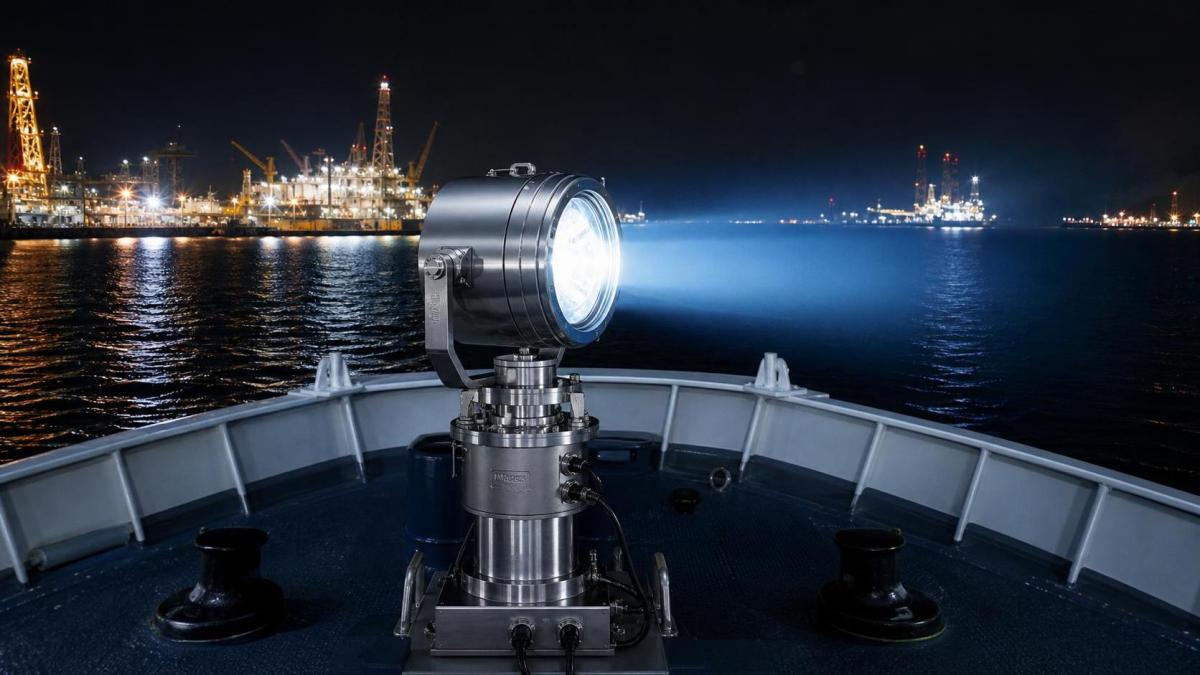
Marine searchlights price often looks inconsistent at first glance. One unit may seem affordable, while another costs several times more for a similar stated wattage.
The reason is simple. Buyers are not paying for brightness alone. They are paying for survivability, beam control, safety compliance, and predictable performance at sea.
In practical terms, the total cost depends on where the light will operate. A harbor patrol vessel, offshore platform, rescue craft, and naval support ship rarely need the same configuration.
That is why marine searchlights price should be reviewed as a system cost. The housing, optics, controls, mounting, cable routing, and maintenance access all influence the final number.
This matters even more in sectors followed by SESS, where mission reliability and certification are tied to operational risk. A failed light during docking, rescue, or perimeter scanning can trigger costs far beyond replacement.
A better question is not “What is the cheapest unit?” It is “Which specification prevents overspending later?” That shift usually leads to better budget decisions.
What exactly are you paying for beyond the lamp itself?
Catalog pricing usually highlights power, lumen output, or beam distance. Those numbers matter, but they do not explain the full marine searchlights price.
More often, cost rises because the searchlight must survive salt spray, vibration, wind loading, and continuous exposure to moisture. Marine-grade materials are not optional in those conditions.
The most common cost drivers include:
- Housing material such as stainless steel, marine aluminum, or coated brass.
- Optical precision for narrow long-range beams or wider search patterns.
- Motorized pan and tilt systems with joystick, bridge, or remote integration.
- Ingress protection, shock resistance, and anti-corrosion finishing.
- Classification, test reports, or special compliance requirements.
- Spare parts support and documented service intervals.
There is also a technology choice underneath the quote. LED systems usually reduce lamp replacement frequency, while xenon or halogen designs may still appear in legacy fleets or specific beam applications.
So when marine searchlights price looks high, it often reflects reliability engineering rather than simple mark-up. In harsh environments, that distinction is important.
How do beam performance and control features change total cost?
A searchlight used for visual identification at long distance is priced differently from one used for short-range deck operations. Beam performance changes both component selection and control complexity.
Longer throw distance usually demands better optics, stronger thermal management, and more stable aiming. That pushes marine searchlights price upward, even before installation is considered.
Remote control functions also add cost, but they often improve safety and efficiency. This is especially relevant when operators must stay protected inside a wheelhouse or control room.
A useful way to compare options is to separate the visible purchase price from the hidden operating effect:
If the light will only be used during low-speed harbor maneuvers, premium beam range may not repay the extra spend. If identification range is critical, under-specifying can become the larger cost.
Are certification and marine durability worth the extra money?
Usually, yes. This is where short-term savings can become expensive. Marine searchlights price often increases when buyers ask for stronger compliance documentation or tougher environmental protection.
That increase is not cosmetic. In many operations, evidence of safety, electrical integrity, and resistance to corrosion reduces approval delays and future replacement risk.
Some applications also overlap with the broader high-risk equipment logic seen across SESS sectors. Just as ATEX lights or rescue robots are judged by reliability under stress, marine searchlights are evaluated by whether they keep working when conditions deteriorate.
It helps to verify four points early:
- Whether the vessel or site requires class-related documentation.
- Whether salt fog, vibration, or ingress testing is documented.
- Whether replacement parts remain available for several years.
- Whether coatings and seals are proven for continuous marine exposure.
Without those checks, a lower quote may hide weak lifecycle value. A corroded enclosure, fogged lens, or failed control motor can erase the apparent savings very quickly.
Where do budgets often go wrong when comparing quotes?
The most common mistake is comparing unit price without comparing scope. Two suppliers may both list a marine searchlight, but they may not be pricing the same thing.
One quote may include controller, mounting bracket, marine cable set, commissioning support, and spare seals. Another may only cover the head unit.
Another problem is ignoring installation realities. Retrofit projects often need reinforcement, cable routing changes, power conversion, or bridge control adaptation. Those items can exceed the difference between product quotes.
A more reliable review process is to ask these questions before approval:
- Is the quoted marine searchlights price for equipment only or a functional package?
- Are installation accessories, controls, and documentation included?
- What is the expected maintenance interval in saltwater use?
- How long is the lead time for spare parts and service response?
- Will the supplier support inspection, testing, or commissioning evidence?
In real projects, the best quote is often the one with fewer surprises, not the one with the lowest starting figure.
How should total cost be judged over the full service life?
A sensible decision looks beyond procurement and asks how the light behaves over five to ten years. That is where marine searchlights price becomes a lifecycle discussion.
Energy use may matter, but service interruption matters more. If a failed unit delays inspection, docking, patrol, or emergency response, indirect costs rise quickly.
More durable systems usually create value in three ways. They need fewer interventions, produce less unplanned downtime, and simplify compliance records during audits or technical reviews.
That is why many technical portals, including SESS, emphasize operational reliability rather than headline specification alone. In safety-linked equipment, maintenance behavior is often as important as purchase price.
A practical shortlist should weigh:
- Initial marine searchlights price and included scope.
- Expected service life of light source and motors.
- Corrosion resistance in the actual operating region.
- Maintenance access time and spare part availability.
- Operational consequence if the system fails at a critical moment.
When these points are documented side by side, the approval decision becomes easier. The conversation moves from “cheap versus expensive” to “predictable cost versus recurring risk.”
What is the smartest next step before approving a marine searchlight purchase?
Start by defining the operating scenario, not the product name. A vessel used for rescue support, perimeter observation, or offshore transfer will value different features.
Then request quotes in a normalized format. That means beam range, material, controls, certification, accessories, warranty, and maintenance assumptions should be clearly separated.
It also helps to ask for evidence from comparable deployments. Proven field use often says more than a polished brochure, especially in marine and other mission-critical equipment sectors.
Marine searchlights price makes sense only when linked to performance, durability, and support. If one quote is much lower, the missing cost is usually hiding somewhere else.
The most effective approach is to build a short comparison sheet, confirm lifecycle assumptions, and challenge vague line items before approval. That reduces both budget friction and technical regret later.
When the requirement is clear, the right decision is rarely the lowest number on the page. It is the option that delivers stable output, manageable upkeep, and fewer operational compromises over time.
Related News
Get weekly intelligence in your inbox.
No noise. No sponsored content. Pure intelligence.
